








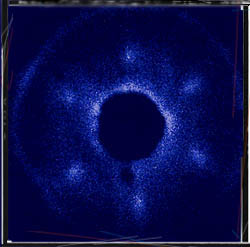
This is an atomic force image of one of the most important substances on earth. As the image shows, it forms hexagonal, or six-sided crystals at temperatures below 0C. It has a density when liquid of 1.0 g/cm3. It has a gram formula weight (molecular mass) of 18.02 grams. It is covalently bonded. The first correct e-mail to Mr. K identifying this substance earns 50 extra credit points
This is my best idea of the schedule. It will be adjusted as progress and materials determine. Please check the Schedule whiteboard in the classroom daily. Follow the underlined links for more information on topics that are giving you trouble.
| Week | Topic | Activity/Lab |
| 10 |
Unit 7 Gas Laws |
Charles
Law lab: complete Lab write-up.
Test 7.x Boyles and Charles' Law |
| 11 |
Unit 8 : Combo Gas Law with water vapor corrections Mass-volume stoichiometry with vapor pressure corrections |
O2 Lab with water vapor correction.
Test 7.y Ideal and Combo Gas Laws. |
| 12 |
Finish Gas Laws Unit 9: Atomic structure. |
Test 8.x Mass volume stoichiometry with vapor pressure correction. |
| 13 | Test 9.x Electron configurations and bonding | |
| 14 | Unit 10: Lewis dot diagrams and molecular geometry | |
| 15 | VSEPR theory and molecular geometry | Test 10.x Bonding, atom, Lewis dot diagrams |
| 16 | Unit 11: Thermochemistry
Thermochemistry: Water (This example uses joules. 1 calorie is 4.184 J Great conceptual heating curve) |
|
| 17 | Finish Thermochemistry | Test 17.1 Thermochem.
Lab Final: Heat of fusion of water (very similar to our lab). |
| 18 |
Review for mid-Term (Review Old Tests) Take Practice --> |
In class Mid Term Review
Key (self-check)
Review & Practice mid-Term Final Chemistry mid-Term. :) |
Remember this is an ideal syllabus. Our progress may be quite a bit slower. This is still the order subjects will be taken in.
Chemists are, on the whole, like physicists, only 'less so'. They don't make quite the same wonderful mistakes, and much what they do is an art, related to cooking, instead of a true science. They have their moments, and their sources of legitimate pride. They don't split atoms, as the physicists do. They join them together, and a very praiseworthy activity that is.
Anthony Standen, Science is a sacred cow (1958).
Click here for the 3rd Quarter Schedule
To report a dead or missing link click here: