


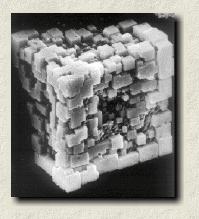
Okay, time for more questions: Man-made or natural? What state of matter? When was the last time you used this ionic substance? Is this crystalline? Could it be a mineral?
| Week | Topic |
Nevada Stds. |
Activity |
| 19 | |||
| 20 | Astronomy: What is a universe?
Age of Universe |
E.12.B.5:
Scientific evidence suggests that the universe is expanding.
E.12.B.3:Students know ways in which technology has increased understanding of the universe.
|
Video: Trouble with the Universe.
|
| 21 | Life cycle of stars
Even more on life cycle of stars Online Review: Stars and Universe Quiz: Stars and Universe |
E.12.B.1:
Common characteristics of stars.
E.12.B.2: Stars are powered by nuclear fusion of lighter elements into heavier elements, which results in the release of large amounts of energy. E.12.B.4 Students know the on-going processes involved in star formation and destruction.
|
Star-life cycle packet and interactive lab. |
| 22 | Our neighborhood: The solar system. | E.8.B.7: Students know regular and predictable motions of Earth around the Sun and the Moon around the Earth explain such phenomena as the day, the year, phases of the Moon, and eclipses. | |
| 23 | Solar system continued. | E.8.B.7: Students know regular and predictable motions of Earth around the Sun and the Moon around the Earth explain such phenomena as the day, the year, phases of the Moon, and eclipses. |
Lab 4: Eccentricity of orbits: Kepler's Laws |
| 24 | Space buddies: Our
moon's origins.
Solar Eclipses , Lunar eclipses and Seasons Online Review: Solar system and moon. Quiz: Solar system and moon |
E.8.B.7:
Students know regular and predictable motions of Earth around the Sun and
the Moon around the Earth explain such phenomena as the day, the year,
phases of the Moon, and eclipses.
E.12.A.4 Students know convection and radiation play important roles in moving heat energy in the Earth system. |
Lecture notes and demos.
We seem seriously behind this year. Entering 4th quarter we are starting Astronomy. Eighth grade standards will not be reviewed due to lack of time. |
| 25 | Astronomy and Space Exploration |
N.12.B.1: Science, technology, and society influenced one another in both positive and negative ways. |
|
| 26 | Earth Science: Our home planet
Layers like onions.... Atmosphere, Hydrosphere, Lithosphere, Asthenosphere |
N.12.A.1 Students know tables, charts, illustrations and graphs can be used in making arguments and claims in oral and written presentations. N.12.A.5 Students know models and modeling can be used to identify and predict cause-effect relationships. |
Lab 5: Earth Egg
Cornstarch plastic Demo. |
| 27 | Rocks, minerals and the rock cycle. | E.12.C.2:Students know elements exist in fixed amounts and move through solid earth, oceans, atmosphere and living things as part of biogeochemical cycles. | Lab 6: Moh's hardness scale
Lab 7: Big 3 Rock Types: Igneous, Sedimentary, and Metamorphic. |
For the fourth nine weeks schedule: click HERE
To report a dead or missing link click here: